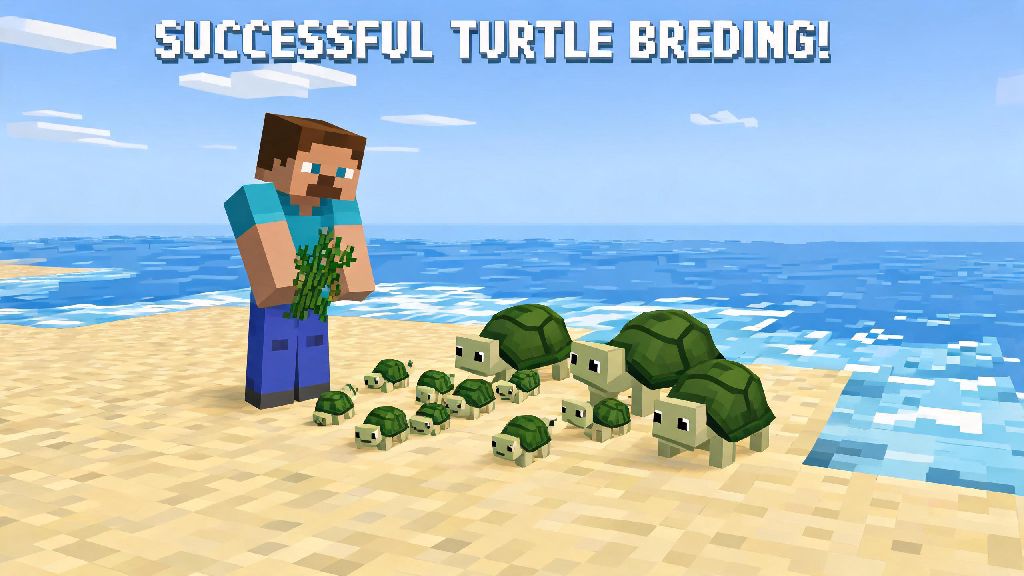
If you've ever explored warm ocean biomes in Minecraft, you've probably spotted those slow, gentle turtles bobbing in the water or crawling along sandy shores. They're not just cute decorative mobs either—breeding them gives you access to scutes, a rare material that lets you craft turtle shells for extra underwater breathing time, and even potions of the turtle master for massive damage resistance. If you're wondering how to breed turtles in Minecraft without wasting hours chasing them around the beach, you're in the right place. I've bred dozens of turtle colonies across survival worlds, and I'll walk you through every mistake I made so you don't have to repeat them.
Pre-Requisites to Breed Turtles in Minecraft
First, you need to find two turtles to start your colony. They only spawn in warm ocean biomes, near sandy beaches with no stone or grass blocks adjacent to the shore. Don't waste time looking in cold or lukewarm oceans—they won't spawn there, and you'll just end up swimming in circles for hours. If you're having trouble finding them, try exploring coastlines near desert biomes, since those almost always connect to warm ocean zones.
Next, you need seagrass as their breeding food. You can harvest seagrass with shears from any ocean biome; if you break it without shears, it drops nothing, so don't skip grabbing a pair of iron shears before you head out looking for turtles. Seagrass is super common, so you can stock up on a full stack in just a minute or two once you find a patch.
You also need to make sure the area you're breeding them in has at least two blocks of sand above the high tide line. Turtles will only lay eggs on sand, and they always return to their home beach (the block they spawned on) to lay eggs. I made this mistake once early on, I dragged two turtles thousands of blocks to my base beach, fed them seagrass, and waited for eggs for hours. Turns out they kept trying to swim back to their original spawn beach, so I had to either build a farm at their native shore or use silk touch to move their home sand blocks to my base. If you don't want to deal with that, just set up your breeding area within 50 blocks of where you found the turtles.
Step-by-Step Process to Breed Your First Turtle Pair
Once you have your two turtles in a contained, sandy area near their home beach, hold seagrass in your hand. Turtles will follow you as long as you're holding seagrass, so you can easily herd them into a fenced-off area if you don't have leads to tie them up. Leads work on turtles too, but they move super slow on land, so you might want to use a boat to transport them through water if they're far from the spot you want to set up.
Once they're both close to each other, right-click (or tap, if you're on mobile/console) on each turtle with the seagrass to feed them. You'll see red hearts appear over their heads when you feed them correctly, just like with other breedable mobs. Don't feed them extra seagrass once the hearts show up—it won't speed up the process, and you'll just waste your supplies.
Once both have hearts, they'll move close to each other and mate. After a few seconds, one of the turtles will become pregnant—you'll notice it looks a little bigger, and it will start moving towards the nearest sand block to lay eggs. Don't disturb the pregnant turtle while it's looking for a spot to lay eggs. If you hit it or lead it away, it will lose the pregnancy and you'll have to breed them again. Once it finds a suitable sand block, it will dig for a few seconds and lay 1-4 turtle eggs.
It's critical to protect the eggs right after they're laid. Mobs like zombies, skeletons, wolves, and even foxes will intentionally trample turtle eggs if they get close, so you need to put up fences or light up the area around the eggs to keep hostile mobs away. You also can't step on the eggs yourself—if you jump on them or walk on them too much, they'll break. If you need to move the eggs, use a silk touch enchanted pickaxe to mine them, otherwise they'll break instantly.
How to Hatch Turtle Eggs and Grow Your Colony
Turtle eggs take time to hatch, and they only progress towards hatching during the night time in Minecraft. If you're playing in survival, you can sleep through the nights to speed up the process, but don't sleep too far away from the eggs—they have to be in your loaded chunk area to progress. On average, eggs take 4-5 in-game nights to hatch fully, but it can be a little faster or slower depending on random game ticks.
Once the eggs hatch, you'll get tiny baby turtles. Baby turtles are even more fragile than eggs, so keep them away from hostile mobs, and don't let them fall from heights. Baby turtles will automatically head towards the nearest water source as soon as they hatch, so make sure there's a safe body of water nearby for them to swim into. I like to build a small, enclosed pond right next to the breeding beach so the babies don't swim out into the open ocean where hostile mobs can attack them.
You can feed baby turtles seagrass to speed up their growth rate—each piece of seagrass cuts 10% off the time it takes for them to become full adults. Once a baby turtle grows into an adult, it will drop one scute, which is the material you need to craft turtle shells. That's the main reward for breeding turtles, so don't leave baby turtles unattended before they grow up, or you'll lose out on that scute. Also, once the baby turtle grows up, it will set its home beach to the spot it hatched on, so you can breed those new adults right there in your farm without having to worry about them swimming back to a different beach.
Top Benefits of Breeding Turtles Regularly
A lot of new players write off turtle breeding as a pointless aesthetic activity, but it actually gives you access to some of the most useful late-game items in Minecraft. The key benefits include:
I keep a small turtle colony near every survival base I build, even if I don't spend a lot of time in the ocean. The turtle master potions have saved my life more than once during tough boss fights, and the extra breathing time from the shell helmet means I don't have to waste inventory space on extra potions of water breathing when I'm exploring shipwrecks or ocean monuments. You can even use turtle shells as a trade item with villagers if you have extra scutes lying around.
Breeding turtles doesn't have to be a confusing, time-consuming process if you follow the right steps. You don't need any fancy gear or rare materials to get started, just a pair of shears to harvest seagrass and a safe spot near a warm ocean beach. Once you get the hang of how to breed turtles in Minecraft, you'll have a steady supply of scutes and powerful buffs that make both ocean and land survival way easier. Start small with just two turtles, and you'll have a thriving colony in no time at all.