If you’ve ever fumbled with messy water bucket spills while building a pixel art fountain, or needed a safe spot to store dye for leather armor customization, you’ve probably wished you had a cauldron nearby. Figuring out how to make a cauldron in Minecraft is one of those small, game-changing crafting wins that makes both survival and creative play far smoother. I’ve been playing Minecraft for over 8 years, and I still keep at least two cauldrons in every base I build—one outside for rain collection, and one inside my potion lab. This guide will walk you through every step, plus hidden uses you might not have tried yet.
How to Make a Cauldron in Minecraft: Required Materials and Crafting Steps
Crafting a cauldron is far simpler than most new players expect, and you don’t need any rare or hard-to-find items to pull it off. The only material you need is 7 iron ingots, which you can get by smelting raw iron ore in a furnace, looting zombie drops, or grabbing extra from village blacksmith chests. If you’re early in a survival playthrough, you can usually get enough iron for a cauldron after just one short mining trip to y-level 15 or lower.
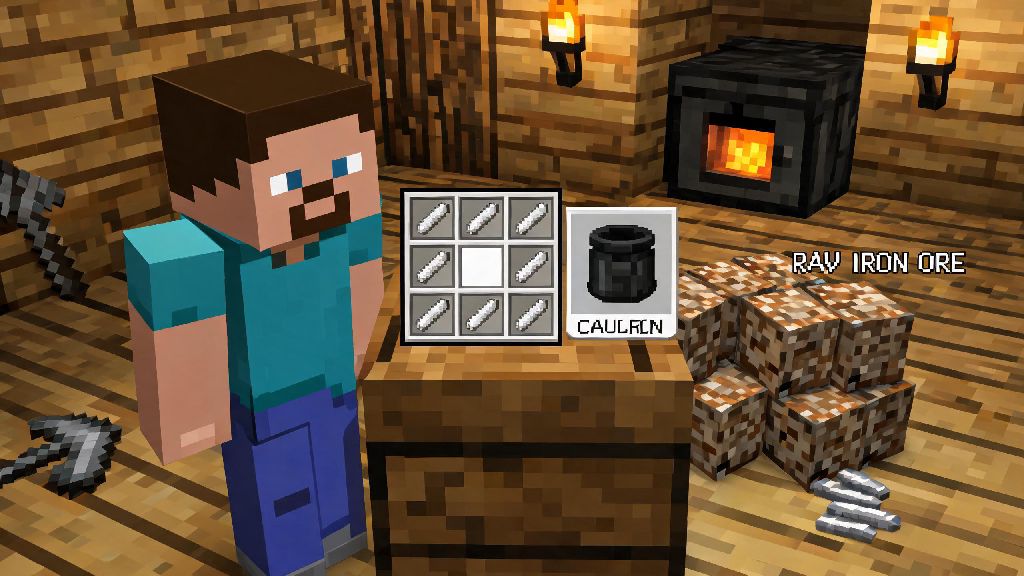
To craft the cauldron, open your 3x3 crafting grid and place the iron ingots in a U-shape: 3 ingots down the left column, 3 ingots down the right column, and 1 ingot in the bottom center slot. Leave the top center and middle center slots empty, then drag the finished cauldron to your inventory. You only need 7 iron ingots to craft a single cauldron, making it one of the most low-cost utility blocks in the game.
If you don’t want to craft your cauldron, you can also find them spawning naturally in witch huts, igloo basements, woodland mansion rooms, and village blacksmith shops. But crafting is almost always faster, especially if you already have an iron farm set up on your base.
Core Cauldron Uses for Survival and Creative Play
Cauldrons aren’t just decorative blocks for witch-themed builds—they have a ton of practical uses that can make your daily gameplay way more convenient. Most players only use them for water storage at first, but they have far more functionality than that. Here are the most useful ways to use your cauldron once it’s crafted:
That means you don’t have to waste chest space storing dozens of water buckets if you have a single cauldron by your crop farm or furnace stack. I once built a small desert base where the nearest water source was 200 blocks away, and a rain-fed cauldron was the only way I kept my crop farm alive for the first two months of play. If you're playing on a multiplayer server, cauldrons are also a great way to share potions with base mates without having to pass individual bottles back and forth.
Common Mistakes to Avoid When Using Cauldrons
A lot of new players assume cauldrons work exactly like regular water or lava blocks, but that’s not the case. For example, you can’t use a cauldron of water to put out fires on adjacent blocks, so don’t rely on it as a fire safety measure near your nether portal. It also won’t hydrate farm crops, so you’ll still need a regular water source next to your wheat or potato rows.
You also can't fill bottles directly from a cauldron of water in Bedrock edition, so if you're playing on mobile or console, you'll still need a separate infinite water source for potion brewing. This is one of the biggest differences between Java and Bedrock cauldron mechanics, and it trips up new cross-platform players all the time.
Another common mistake is adding multiple dyes to the same cauldron. Unlike real paint, mixing dyes in a cauldron doesn't create a new custom color—it just resets the water to clear, wasting all the dye you added. I learned this the hard way when I tried to make a custom purple dye for my leather armor set and wasted three diamonds worth of lapis and rose red. Never use a cauldron of lava near wooden builds, even if it seems contained—one misclick with a flint and steel can burn your entire base to the ground in seconds.
If you place a cauldron in the nether, any water you add to it will evaporate immediately, so only use cauldrons for lava or powder snow in nether bases. You also can’t use cauldrons to pick up lava in Creative mode, so you’ll still need to use buckets for that if you’re building custom nether landscapes.
Creative Cauldron Build Ideas to Try
Once you know how to craft and use a cauldron for basic utility, you can use it for all kinds of fun decorative builds too. I've used cauldrons as part of witch hut decor for adventure maps, as small planters for nether wart in potion labs, and even as fake cooking pots in medieval kitchen builds. One of my most popular creative builds uses a lit cauldron of lava under a glass block as a cheap, low-maintenance table lamp for dark basement areas.
You can also use cauldrons as part of custom fountain builds, or as target practice for archery minigames on multiplayer servers. If you’re building a Halloween-themed base, add a cauldron with purple potion and a few floating item frames with nether wart around it to make a spooky witch's brew station. You don’t need any mods to pull off these builds—all you need is a few basic blocks and a little creativity.
For survival players, you can even hide a chest under a cauldron to make a secret storage spot for your most valuable items. Most other players on multiplayer servers won’t think to check under a random cauldron sitting by your front door, so it’s a great low-effort hiding spot for diamonds or enchanted gear.
At the end of the day, even if you only use it for storing extra water buckets, the cauldron is one of the most underrated utility blocks in Minecraft. Now that you know how to make a cauldron in Minecraft, you can start experimenting with all its hidden uses to make your playthroughs far more convenient and fun. Don't be afraid to test out weird decorative uses for it either—some of my favorite base features started as random experiments with cauldrons I had lying around after mining trips.