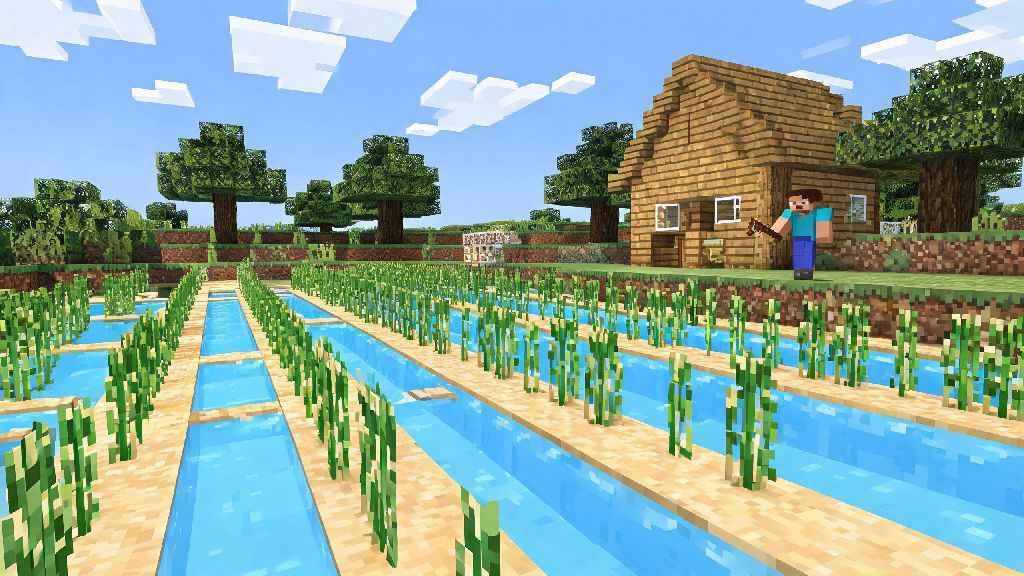
If you’ve ever found yourself short of paper for enchanting tables, rockets for elytra flights, or sugar for potions and cake baking, you’ve probably wondered how do you farm sugar cane in Minecraft reliably. Unlike wheat or carrots, sugar cane has specific growth rules that a lot of new players miss, leading to slow harvests and wasted resources. I’ve spent years testing different farm designs across both Java and Bedrock editions, so I’ve broken down everything you need to know to build a farm that fits your playstyle, whether you’re a new survival player just setting up your first base or a veteran looking for a low-effort automatic setup.
Core Rules to Remember When You Farm Sugar Cane in Minecraft
First off, you can’t skip these basic growth rules, because ignoring even one will make your farm produce next to nothing. Sugar cane only spawns and grows on blocks directly adjacent to water source blocks – that means flowing water won’t work, and the block has to be at the same y-level as the water, not one level above or below. It can grow on grass, dirt, coarse dirt, rooted dirt, moss blocks, sand, red sand, or mud, so you don’t have to go digging for sand if you don’t want to, though sand is usually the easiest to clear for large farm plots.
Each sugar cane plant can grow up to 3 blocks tall, and it grows one block every 18 minutes on average, though random tick speed means some plants will grow faster than others. You only need to break the top two blocks of a fully grown plant to harvest – leave the bottom block in place, and it will regrow automatically, so you don’t have to replant every time. That’s the biggest mistake new players make: yanking out the whole plant, which wastes time and resources replanting every harvest.
If you’re playing on Bedrock edition, note that sugar cane has a small chance to grow an extra block tall if it’s next to a beehive with bees working inside, but that’s a minor buff you don’t need to prioritize for basic farms. Java edition doesn’t have that mechanic, so you can skip the beehives if you only play Java.
Easy Manual Sugar Cane Farm for New Survival Players
If you’re in your first few days of a survival world and don’t have access to redstone components yet, this manual farm takes 10 minutes to build and produces more than enough sugar cane for early game needs. This is the most reliable way to farm sugar cane in Minecraft for new players who don’t have redstone yet, and I use this exact design for every new world I start, because it’s cheap, low-effort, and fits in a tiny space next to your starter base.
Here’s what you’ll need to build it:
To build it, dig two 3-block long trenches one block deep, spaced two blocks apart from each other. Fill both trenches with water source blocks, then place a block of sand on each side of both trenches, so you have 6 sand blocks per trench, 12 total. Plant one sugar cane on each sand block, and you’re done. You can harvest this farm every 30 to 45 minutes by running along the rows and breaking the top two blocks of each plant, and you’ll get roughly 24 sugar cane per harvest, enough for 8 paper or 24 sugar right away.
The only downside of this design is that you have to harvest it manually, but for early game, that’s not a problem at all. I usually keep this farm running even after I build an automatic one, just for quick harvests when I need a small amount of sugar cane last minute.
Fully Automatic Sugar Cane Farm for Mid to Late Game
Once you have access to pistons, observers, and hoppers, you can build an automatic farm that runs 24/7 with zero input from you, even when you’re off exploring other parts of your world. This design works for both Java and Bedrock editions, and you can expand it as much as you want to produce thousands of sugar cane per hour. This is one of the most low-maintenance ways to farm sugar cane in Minecraft for late game, since you never have to touch it once it’s built.
The core mechanic is simple: observers are placed facing the second block of each sugar cane plant, and when the plant grows to 3 blocks tall, the observer detects the block update and sends a redstone signal to a piston that pushes and breaks the top two blocks. The broken sugar cane falls into a water channel that flows into a hopper, which feeds into a chest for easy collection. Make sure you put a solid block behind each observer, otherwise the redstone signal won’t send correctly to the pistons, and you’ll have plants that grow full height without being harvested.
You can build a 4-row version of this farm with just 4 pistons, 4 observers, 8 hoppers, 2 chests, and 16 sand blocks, and it will produce roughly 150 sugar cane per hour. That’s enough to make hundreds of fireworks rockets for elytra travel, or stockpile paper for trading with librarian villagers for enchanted books. I have a 16-row version of this farm on my main survival server, and I only have to empty the chests once every two weeks, even with multiple players using the sugar cane regularly.
One small thing to watch out for: if you’re playing on a multiplayer server, make sure your farm is in a chunk that stays loaded when you’re offline, otherwise it will stop growing when you log out. Most servers let you set a small number of chunk loaders for your base, or you can ask an admin to mark your farm chunk as permanently loaded if it’s for public use.
Common Sugar Cane Farming Mistakes to Avoid
Even if you follow all the build steps, there are a few common mistakes that can cut your farm’s production in half, or stop it working entirely. I’ve made every single one of these at some point, so I can tell you exactly what to watch for.
First, don’t place blocks above your sugar cane farm. Sugar cane needs a light level of at least 8 to grow, so if you build a roof over it without placing torches or other light sources, it will stop growing entirely. If you want to build a roof to keep mobs from spawning on your farm, place glowstone or sea lanterns every 5 blocks along the roof to keep the light level high enough for growth. You can also use shroomlights if you prefer the look of them, they work just as well.
Another mistake is placing your farm too close to other crop farms that use water. If you have a wheat farm next to your sugar cane farm, you might accidentally break the water source blocks for the sugar cane when you’re tilling soil for wheat, which will make all your sugar cane break immediately. I always leave at least 3 blocks of space between my sugar cane farms and other crop plots to avoid this.
Don’t use bone meal on sugar cane if you’re playing on Java edition – it won’t make it grow faster, so you’re just wasting bone meal you could use on wheat or trees. Bone meal does work on sugar cane in Bedrock edition, though, so you can use it to speed up harvests for manual farms if you’re playing on Bedrock.
At the end of the day, figuring out how do you farm sugar cane in Minecraft doesn’t have to be complicated, even if you’re new to the game. Start with the basic manual farm when you first spawn, upgrade to the automatic design once you have redstone components, and avoid the common mistakes we covered, and you’ll never run out of paper, sugar, or fireworks again. I’ve used these designs for years across dozens of worlds, and they’ve never let me down, even when I need huge amounts of sugar cane for big builds or server trading systems. Try them out for your next world, and you’ll be shocked at how much time you save compared to foraging for sugar cane along rivers every time you need it.