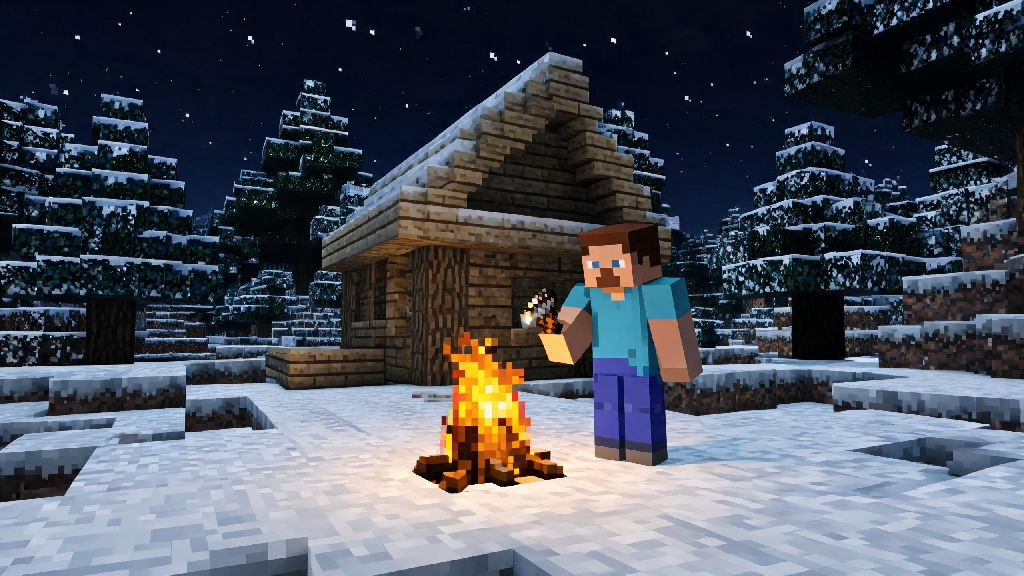
I still remember my first week playing Minecraft Survival, freezing in a dirt hut at night while creepers lurked outside, no clue how to keep warm or cook the raw beef I’d just scavenged. If I’d known how to make a campfire in Minecraft back then, I would have saved myself three trips back to spawn after dying of hunger or mob attacks. This guide breaks down everything you need to know to craft, place, and use your campfire safely, no fancy mods or hard-to-find resources required. Whether you’re playing on a public survival server or a private world with friends, this basic utility block will quickly become one of your most relied-on items.
What You Need to Make a Campfire in Minecraft
Crafting a campfire only requires four easy-to-find materials, most of which you can collect within your first 10 minutes of a new survival run. The recipe is identical across Java and Bedrock editions, so you don’t have to adjust anything if you switch between platforms. You’ll need a 3x3 crafting table to assemble it, since the recipe uses 7 total items that won’t fit in your personal 2x2 crafting grid.
Here’s the full list of required materials, plus tips to collect them fast:
To assemble, arrange the 3 logs across the bottom row of your crafting grid, place the charcoal or coal in the center slot, then put one stick in the top middle, one in the middle left, and one in the middle right slot. You’ll get one campfire per craft. If you’re early in your survival run, prioritize charcoal over coal to save your coal for torches or furnace fuel later. You can also pick up pre-made campfires for free if you find them in villages, taiga cabins, or ruined portal chests, no crafting required.
How to Place and Use Your Campfire Safely
Once you have your campfire, placement is key to avoiding accidental damage to your base or inventory. You can place a campfire on any solid, full block, but you need to keep flammable blocks at least 2 blocks away from it unless you have fire spread turned off on your server. Campfires give off a small amount of heat that can ignite wood, leaves, wool, and other flammable blocks even if they’re not directly touching the fire.
When placed correctly, a campfire has a ton of practical uses for survival play. It works as a light source that gives off light level 15, the same as a regular torch, so mobs won’t spawn within 16 blocks of it. You can cook up to 4 raw food items on it at once by right clicking the campfire with the food in your hand, and it doesn’t require any extra fuel to work. Food takes 30 seconds to cook on a campfire, which is slower than a furnace, but it’s free, so it’s perfect for early game when you don’t have a lot of coal saved up.
Campfires also emit a smoke trail that rises 10 blocks straight up, making it a great temporary marker for your base when you’re out exploring. If you place a hay bale directly under the campfire, the smoke will rise 24 blocks instead, so you can see it from much farther away. Never place a campfire directly next to your bed or entryway, you'll take damage every time you walk over it by accident. If you need to put a campfire out temporarily, you can right click it with a shovel, pour a water bucket over it, or throw a splash water bottle. You can relight it any time with flint and steel or a fire charge.
Creative and Practical Campfire Uses for Every Playstyle
Campfires aren’t just for early game survival, they work for all playstyles from casual survival to advanced creative builds. For survival players, one of the most useful hidden features of campfires is their ability to calm bees. Place a campfire 1-2 blocks directly under a beehive to harvest honey safely without getting swarmed. The smoke from the campfire makes the bees passive, so you can take honey bottles or honeycomb without taking any damage. You can also use campfires as low-effort mob traps: place one under a carpet, and mobs will walk over the carpet without noticing the fire, taking consistent damage until they die. It’s a great way to set up a simple zombie or skeleton farm near your base without a lot of complex redstone.
If you play creative mode or love building, campfires are a super versatile decoration block. You can use them to create realistic camp sites for roleplay worlds, add cozy fireplaces to cabin builds, or even make fake cooking stalls for village markets. You can also craft a soul campfire for a different look: swap the regular coal/charcoal for a piece of soul sand or soul soil, and you’ll get a blue fire that gives off a dimmer, moodier light. Soul campfires are a must-have for Nether base builds, as they prevent piglin brutes from attacking you unprovoked. They also emit gray smoke instead of white, which is perfect for industrial builds or spooky haunted house decorations.
For players who run multiplayer servers, campfires are a great way to mark public areas like spawn points, shared resource farms, or community event spaces. You can place multiple campfires around a shared base to light the area without having to place hundreds of torches, and they look much more natural for medieval or rustic server themes.
Common Campfire Mistakes to Avoid
Even though campfires are simple to use, I’ve made my fair share of mistakes with them over the years that cost me resources, bases, and even pet wolves. First, don’t forget that campfires don’t automatically deposit cooked food into your inventory like a furnace does. You have to right click the campfire to take the cooked food off, so don’t leave raw food on it and walk away expecting it to be in your chest when you get back. It won’t burn if you leave it on too long, but you can only store 4 items at a time, so it’s not a good long-term food storage solution.
Second, don’t place campfires too close to flammable blocks if fire spread is turned on. I once lost my first fully upgraded wooden base because I left a campfire next to a stack of oak planks I’d set down while building an extension. I came back from a mining trip to find half my base burned to the ground, including all my diamond tools and enchanted gear. Now I always place my campfires on a 3x3 pad of cobblestone or stone to avoid any accidental fires, even if I’m building a wooden structure.
Third, don’t use anything other than an axe to break a campfire. You can break a campfire with any tool, but axes are the fastest, and you’ll always get the campfire as a drop when you use an axe. If you use a pickaxe or your fist, it takes way longer, and you might lose the drop if you’re in a hurry to move it. Always fence off campfires if you have pet wolves or cats in your base to prevent accidental damage. I lost my first tamed wolf when it wandered onto a campfire I left unattended near my bed, and I’ve been careful to block them off ever since.
One last mistake to avoid: don’t try to use a regular campfire underwater. It will go out immediately when you place it, unless you use a specific trick with waterlogged slabs and glass blocks to trap the air around it. If you need a light source underwater, stick to sea lanterns or glowstone instead.
Once you get the hang of how to make a campfire in Minecraft, you’ll wonder how you ever played survival without it. It’s cheap, versatile, and useful for everything from early game food prep to late game creative builds and base defense. Take the tips we’ve shared here to avoid common mistakes, and experiment with different placement and uses to fit your playstyle. Next time you head out on an exploration run, keep a few extra campfires in your inventory to mark your path, cook food on the go, and keep mobs away while you sleep out in the wild.