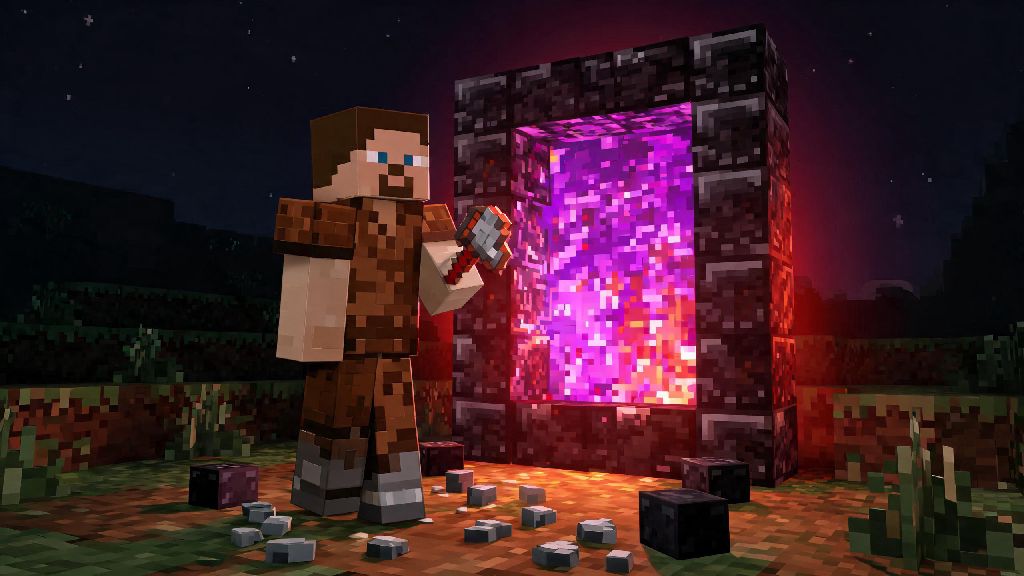
There’s nothing more frustrating than standing in front of an obsidian nether portal, ready to explore the fiery dimension for the first time, only to realize you don’t have the one item you need to light it. If you’ve ever found yourself stuck in that exact spot, you’ve probably searched for how to make flint in Minecraft to get out of the jam. Contrary to what many new players assume, flint isn’t crafted directly in a crafting table, but there are simple, reliable ways to get as much of it as you need, no matter your playstyle. Even veteran players can miss out on faster methods to farm this core resource, so we’re breaking down everything you need to know to stock up fast.
How to Make Flint in Minecraft: Core Mechanics Explained
First, let’s clear up the most common misconception new players have about this resource. You cannot craft flint in a standard crafting table, no matter what materials you combine. The term “make” here refers to obtaining or farming flint, since it only spawns as a drop from specific actions in the game. The primary way to get flint is by breaking gravel blocks, which have a base 10% chance to drop flint instead of a gravel block when broken without silk touch.
Enchantments can drastically change that drop rate, too. A Fortune I enchant on your shovel bumps the drop chance to 14%, Fortune II raises it to 25%, and Fortune III gives you a 100% chance to get flint every time you break a gravel block. Silk touch enchanted tools will never drop flint, even if you break hundreds of gravel blocks with them, so keep that in mind when you’re choosing which shovel to use for mining.
You can also get flint from secondary sources if you don’t want to mine gravel. Fletcher villagers will sell 8 to 10 flint for one emerald, and you can find flint in loot chests in desert temples, jungle temples, village fletcher houses, and ruined portals. These secondary sources are great for early game if you only need one or two pieces of flint for a flint and steel, but mining gravel is far more efficient for bulk supplies.
Fastest Methods to Farm Flint in Bulk
The method you use to farm flint will depend on how far you are in the game, but even new players can get enough flint for their needs in 10 to 15 minutes of work. For early game players who don’t have enchanted tools yet, head to a riverbank, beach, or gravel mountain biome. These areas have tons of exposed gravel, so you can break blocks with a basic stone shovel and get flint every 10 blocks or so on average.
Once you have access to diamond or netherite tools and enchants, the process gets way faster. If you get a Fortune III shovel, every gravel block you break will drop flint, so you can clear an entire gravel mountain in 10 minutes and walk away with multiple stacks of flint. For late game players who want unlimited renewable flint, set up a basic piglin bartering farm. Piglins trade 8 to 16 gravel for one gold ingot, so you can get infinite gravel without ever mining it again.
If you want to set up a dedicated bulk flint farm to keep your storage chests full long-term, you only need a few key items:
If you don’t have Fortune III yet, you can still stretch your gravel supplies further. Every time you break a gravel block and get gravel instead of flint, place it back down and break it again. Each break gives you a new 10% chance to get flint, so you can turn a single stack of gravel into 6 to 7 pieces of flint without doing extra mining. Reusing excess gravel by placing and re-breaking it can double your flint output without extra mining, which is a great trick for mid-game players who haven’t gotten the right enchant yet.
Common Mistakes to Avoid When Collecting Flint
Even players who have been around the block for years make simple mistakes that slow down their flint farming. The most common one is accidentally using a silk touch shovel on gravel. Many players keep a silk touch shovel for building with dirt or grass blocks, and if you grab the wrong one by mistake, you’ll end up with stacks of gravel and zero flint after an hour of mining. Keep your Fortune III flint farming shovel in a separate hotbar slot or label it in your inventory to avoid this mix-up.
Another common mistake is throwing away gravel early game to save inventory space. When you’re first mining for coal, iron, or cobblestone, you’ll run into a lot of gravel veins, and it’s easy to toss the gravel to make room for more valuable resources. But you’ll regret that later when you need hundreds of pieces of flint for arrows or villager trades. Keep at least one stack of gravel in your storage chests at all times, even if you don’t have an immediate use for it.
Wasting emeralds on flint trades early game is another mistake you should avoid. Fletcher villagers sell flint, but it’s a terrible trade when you’re just starting out and emeralds are hard to come by. You can get flint for free by mining gravel, so save your emeralds for high-value trades like enchanted bows or diamond gear. It’s only worth trading for flint if you have excess emeralds and need flint immediately for an emergency, like relighting a broken Nether portal.
Finally, don’t forget to carry extra flint when you’re exploring the Nether. Ghast fireballs can break your Nether portal, and if you don’t have a spare flint and steel, you’ll get trapped in the Nether with no way to get home. Always keep a backup flint and steel in your Nether inventory to avoid getting trapped in the dimension. It takes up almost no space, and it can save you from losing all your hard-earned loot.
Surprising Uses for Flint You Might Have Missed
Most players only use flint to make flint and steel and arrows, but it’s far more versatile than that. One of the most valuable uses for flint is trading with fletcher villagers. You can trade 32 flint for one emerald, which is one of the easiest, lowest-effort ways to get emeralds early game. You don’t need to farm crops, breed animals, or fight mobs to get these emeralds, just mine a few stacks of gravel and you’re good to go.
Leveling up a fletcher villager with flint is also a great investment. Once a fletcher reaches master level, they sell enchanted bows, crossbows, and tipped arrows for very low emerald prices. If you get a fletcher with a Mending bow trade, you can get one of the best weapons in the game for just a few stacks of flint and a handful of emeralds. Fletcher villagers powered by excess flint are one of the most profitable and low-effort emerald farms in vanilla Minecraft.
Flint is also used to make spectral arrows, which are incredibly useful for both PvE and PvP. Spectral arrows mark any target they hit for 10 seconds, even through walls, so you can track hidden mobs or other players easily. They’re especially helpful for fighting creepers in dark caves or fighting other players in forest biomes where visibility is low. You’ll need four pieces of flint, two arrows, and one glowstone dust to make two spectral arrows, so it’s worth stocking up on flint if you use these often.
For creative mode players, flint is a great item for custom builds and adventure maps. You can use it as a collectible item in custom quest lines, display it in item frames in blacksmith or tool shop builds, or use it as part of custom loot tables for dungeons. It’s a small, unassuming item, but it adds a lot of immersion to survival-themed creative builds.
Whether you’re a new player just trying to light your first Nether portal, or a veteran looking to stock up on arrows for a raid, knowing how to make flint in Minecraft will save you hours of frustrated digging. The core trick is prioritizing a Fortune III shovel as soon as you can, so you never have to grind for flint again. Don’t sleep on the trading potential either, since a few stacks of flint can turn into enough emeralds to buy fully enchanted gear in no time. Next time you run into a gravel vein, don’t throw those blocks away – they’re way more valuable than you think.