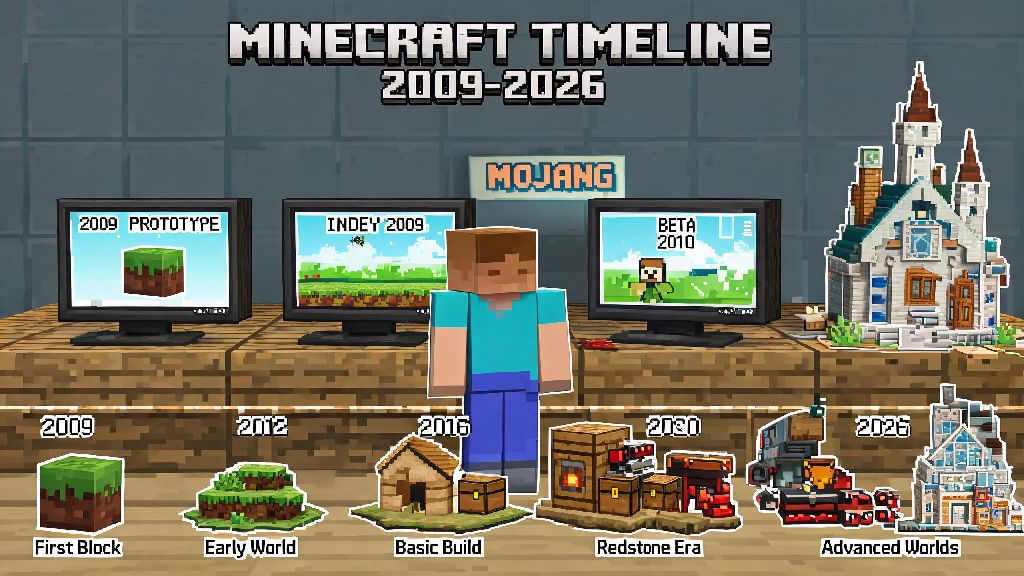
If you’ve spent any time playing blocky build challenges, fighting creepers at dusk, or exploring custom 2026 Minecraft mod packs, you’ve probably wondered at least once when was Minecraft created. The game has become such a staple of global gaming that it’s easy to forget it started as a small side project from a solo developer, not a big-budget studio release. Even in 2026, when we have hyper-realistic open world games and VR Minecraft servers, the core charm of the original release still shines through every new update and community creation. We’re breaking down the full history of Minecraft’s creation, plus how its original design choices still shape how we play the game today.
When Was Minecraft Created? The Full 2009 to 2026 Timeline
Notch, whose real name is Markus Persson, was working at a Swedish game studio called King at the time he started working on Minecraft. He had been experimenting with voxel-based games for years, and after playing the indie title Infiniminer, he decided to combine its block-based mining mechanics with the open world exploration of Dwarf Fortress and the creative building of Rollercoaster Tycoon. He posted the first tech demo, called Cave Game, on an indie game forum on May 17, 2009, and it got positive feedback almost immediately.
The first public build of Minecraft launched just 6 days after Notch started coding it, with only 2 block types, no mobs, and a very basic terrain generation system. Over the next two years, he released regular alpha and beta updates, adding new blocks, mobs, crafting mechanics, and multiplayer support. The full official release of Minecraft came on November 18, 2011, at MineCon in Las Vegas, where thousands of fans gathered to celebrate the game’s launch.
Microsoft acquired Mojang, the studio Notch founded to develop Minecraft, for $2.5 billion in 2014, and has continued to release regular updates ever since. As of 2026, the game has sold over 320 million copies worldwide, with more than 141 million monthly active players, making it the best-selling video game of all time by a huge margin. If you’ve ever downloaded a custom map, played on a community server, or tried a mod pack, you’re benefiting from the work that Notch put into that first tiny 2009 build.
How Minecraft’s Original Design Shapes 2026 Gameplay Features
Many of the choices Notch made in the first year of development still define how Minecraft plays in 2026, even with all the new features added over the past 17 years. He didn’t set out to make a mainstream hit, he just wanted to make a game that let players explore, create, and set their own goals, without rigid rules or forced progression paths. That vision hasn’t changed, even as the game has grown to serve hundreds of millions of players around the world.
Notch intentionally avoided adding rigid quest lines early on, so players could make their own goals. That’s why even in 2026, you don’t have to defeat the Ender Dragon or complete any specific tasks to "beat" the game. You can spend 100 hours building a medieval castle, farming crops, or just exploring random biomes, and that’s a perfectly valid way to play. Three core design choices from the original build are still the foundation of every 2026 Minecraft experience:
You can see this original design philosophy in every 2026 Minecraft update, even as Mojang adds new, more complex features. The 1.32 Deep Wastes update, released in March 2026, added 8 new biomes, 12 new mobs, and over 30 new blocks, but none of these changes force players to engage with them if they don’t want to. You can still play a full survival playthrough without ever stepping foot in the Deep Wastes, just like you could play the 2009 alpha without any of the modern features.
For modders, this philosophy is especially important to remember. Over 70% of top-rated 2026 Minecraft mods prioritize the original core loop over flashy, unnecessary features, according to data from the popular mod hosting platform CurseForge. If you’re just getting started with modding, focusing on small, quality of life improvements that don’t break the core game feel is the best way to build an audience for your work. For example, one of the most popular 2026 mods is a simple inventory sorting tool that makes managing your items easier, without adding any new mobs or mechanics that change how the game plays.
Common Myths About Minecraft’s Creation Debunked for 2026 Players
There are dozens of false claims floating around social media about Minecraft’s origins, especially since the game has become so mainstream. You might have seen false claims online about when was Minecraft created, especially on TikTok or YouTube Shorts where misinformation spreads fast. We’re breaking down three of the most common myths to set the record straight.
The first big myth is that Minecraft was made by a large studio with a multi-million dollar budget. That couldn’t be further from the truth: Notch worked on the game alone for the first six months of development, and only hired a small team of 3 people once the game started selling enough copies to support full-time development. Mojang didn’t grow to more than 10 employees until after the 2011 full release, so it was a tiny, independent project for most of its early development.
The second popular myth is that the creeper was always intended to be the game’s iconic villain. The iconic creeper mob started as a coding error that Notch almost deleted entirely. He was trying to code a pig mob, and accidentally swapped the height and width values, creating a tall, green, lanky mob instead of a short, pink pig. He thought the design looked interesting, so he kept it, added the hissing sound and exploding mechanic, and the creeper was born. It’s now one of the most recognizable video game characters of all time, all from a simple mistake.
The third most common myth is that Minecraft was always designed to be a game for kids. Less than 10% of the 2009 alpha player base was under the age of 18, according to early Mojang surveys. The game’s early audience was almost entirely adult indie game fans, and it only started to gain popularity with younger players after it was added to console platforms like the Xbox 360 in 2012. Even in 2026, over 40% of Minecraft’s monthly active players are over the age of 18, so it’s never been just a kids’ game.
Why Knowing When Minecraft Was Created Matters for 2026 Players
A lot of new 2026 players wonder why they should care about the game’s history, especially when the modern version is so different from the 2009 alpha. But knowing when was Minecraft created and what its original vision was can actually help you get more enjoyment out of the game, no matter what your play style is.
If you’re a creative mode builder, knowing that the game was designed to be accessible for everyone, even people with no prior design experience, can give you the confidence to try more complex builds that you might have thought were out of your skill level. If you’re a survival player, remembering that the game was originally designed to let you set your own goals means you don’t have to follow the "defeat the Ender Dragon" meta that many content creators push. You can spend your entire playthrough building a farm, exploring the world, or just hanging out with friends on a server, and that’s exactly what the game was made for.
If you’re a modder or server owner, sticking to the original vision of accessibility and player freedom will help you build a more engaged, loyal community. Many 2026 Minecraft community events still reference the original 2009 build to celebrate the game’s roots. For example, Mojang ran a 17th anniversary event in May 2026 where players could log into a replica of the 2009 alpha server, play the original build, and compare it to the modern game. Thousands of players participated, including many long-time fans who hadn’t played the alpha in over a decade, and many new players who were shocked at how much of the core game feel was already present in that first tiny build. If you’ve ever asked other long-time players when was Minecraft created, you’ve probably heard a dozen different wrong answers before getting the correct one, but taking the time to learn the real history makes the game feel much more personal and meaningful.
Whether you’re a long-time player who’s been around since the beta days or a new player who just downloaded their first 2026 mod pack, learning when was Minecraft created gives you a new appreciation for the game you love. What started as a tiny side project from a solo indie developer working out of his apartment has grown into a global cultural phenomenon that brings together hundreds of millions of players every year, from school kids building treehouses in creative mode to adult modders creating entire custom game modes. Even as Mojang adds new features, biomes, and mobs every year, the core charm of that first 2009 build is still present in every part of the game. Next time you load up a new world, take a second to remember how far the game has come, and how much it’s stayed the same.