If you’ve ever wanted to build a hidden base entrance, auto-harvest crop farm, or retractable drawbridge in Minecraft, you’ve probably realized you need a piston to make it work. Pistons are one of the most versatile redstone components in the game, so learning how to make a piston in Minecraft is a rite of passage for any player looking to move past basic wooden huts. The recipe works the same across Java, Bedrock, and Pocket editions, so you can follow these steps no matter what platform you play on. You don’t need any rare endgame loot to craft one either, even players in their first few hours of a survival world can pull it off.
What You Need to Know Before You Make a Piston in Minecraft
Pistons are simple blocks that push adjacent blocks (or entities like mobs and players) when activated by a redstone signal. The basic piston only pushes blocks, but you can upgrade it later to a sticky piston that pulls blocks too, if you have slime balls on hand. Before you head to the crafting table, gather these four easy-to-find materials:
You don’t need a special crafting table upgrade to make a piston, the standard 3x3 crafting grid works for all vanilla versions of the game. If you play on a modded server, double check the server’s custom recipe rules, but this layout works for all unmodified Minecraft worlds. I usually keep a stack of each of these materials in my base storage once I hit the iron age, so I can crank out pistons whenever I have a new build idea.
Step-by-Step Process to Craft Your Piston
Once you have all your materials collected, head to your crafting table and open the 3x3 grid interface. If you’re playing on console or mobile, navigate to the crafting menu and make sure all required materials are in your inventory, not just stored in a chest nearby. The layout is specific, so follow it closely to avoid getting the wrong item.
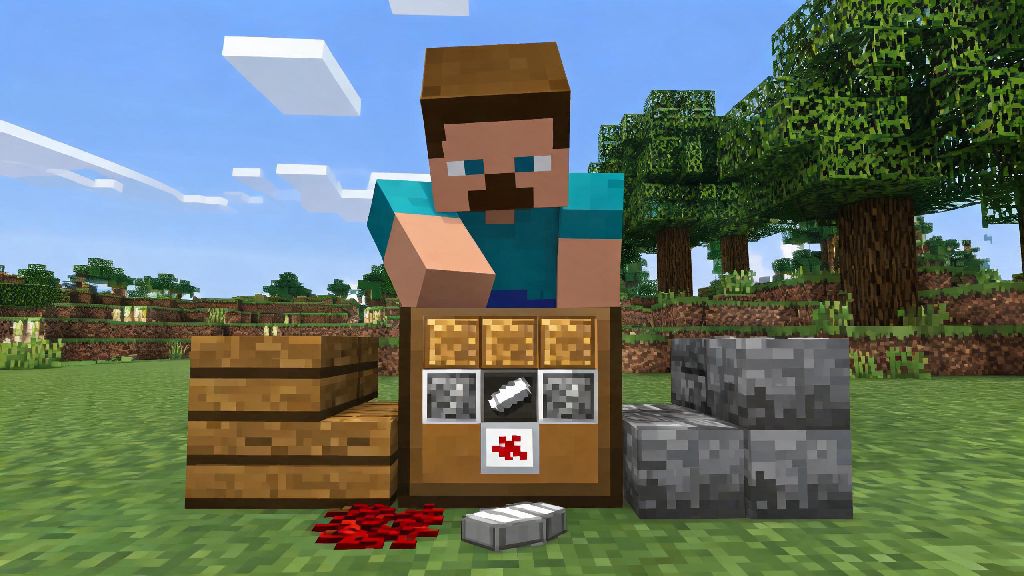
First, fill the entire top row of the crafting grid with your three wood planks. Next, fill the left and middle slots of the middle row with cobblestone, and place the iron ingot in the right slot of the middle row. Finally, fill the left and right slots of the bottom row with cobblestone, and place the redstone dust in the middle slot of the bottom row. Double check the order of your materials if you’re not seeing the piston pop up in the output slot, even one item in the wrong position will give you nothing or a different item entirely.
Once you see the piston appear in the output slot, move it to your inventory and you’re ready to use it. I can’t tell you how many times I’ve swapped the iron ingot and redstone dust when I’m in a hurry to build an auto farm, so take an extra two seconds to confirm the placement before you waste materials. If you have extra materials, you can repeat the process as many times as you want to stock up for future builds.
Common Mistakes to Avoid When Crafting and Using Pistons
Even though the recipe is simple, a lot of new players run into issues either crafting pistons or getting them to work properly. The most common crafting mistake is using the wrong type of stone. Regular stone, deepslate, cobbled deepslate, or blackstone won’t work for the basic piston recipe, only standard cobblestone will give you the correct output. I’ve had friends waste 20 minutes smelting cobblestone into regular stone because they assumed it was the same, so save yourself the time and use unsmelted cobblestone.
When placing pistons, remember that they face directly toward you when you set them down. If you need a piston to push blocks away from your base, stand on the inside of the base when you place it, so it faces outward. If you place it the wrong way, you can break it with a pickaxe and replace it, it will drop itself so you don’t lose any materials.
If your piston won’t activate when you send a redstone signal, first check that the signal is reaching the piston directly. You don’t need a redstone torch right next to the piston to activate it, levers, buttons, pressure plates, and even adjacent redstone dust will all work. Also remember that pistons can only push up to 12 blocks at a time, and can’t push unbreakable blocks like obsidian or bedrock, or blocks with inventory space like chests, furnaces, or shulker boxes. Don’t waste time trying to build a piston system to move your storage room, it won’t work.
Practical Uses for Your New Piston
Once you have a stack of pistons in your inventory, you can use them for dozens of useful builds, whether you play in survival or creative mode. For survival players, the most popular use is automated crop farms. You can set up a row of pistons to push a water source block over mature crops, breaking all of them at once and collecting the drops in a hopper system, so you don’t have to harvest each crop manually. It cuts down farm work time by 90% in my survival worlds, and I don’t have to worry about forgetting to harvest my wheat before it goes to waste.
Pistons are also perfect for hidden base entrances. You can build a wall that looks completely normal, but when you flip a hidden lever, pistons push or retract blocks to reveal a door to your base. It’s a great way to keep your valuables safe from other players on multiplayer servers, or just make your base feel more fun and secret. Sticky pistons are essential for more complex redstone builds like fully retractable hidden doors, so save any slime balls you find from slimes or wandering traders to upgrade your basic pistons.
For creative mode players, pistons let you build animated builds like moving rollercoasters, drawbridges, or even pixel art that changes design when you flip a switch. You can build entire moving structures if you get creative with redstone loops and piston chains. I’ve seen players build fully functional working elevators, automatic armor equipping stations, and even piston-powered mob grinders that collect drops without you having to fight any mobs.
Once you get the hang of the simple recipe, you’ll find yourself reaching for pistons for almost every build you work on, from small quality of life upgrades to massive automated bases. Even if you’re a brand new player who only just built their first crafting table, learning how to make a piston in Minecraft is a small skill that pays off huge for the rest of your playthrough. If you ever forget the layout, you can check your in-game recipe book, which will show you the exact placement once you’ve collected all the required materials. Next time you’re brainstorming a new build, see if a piston can make it work better, you might be surprised how versatile these little blocks are.