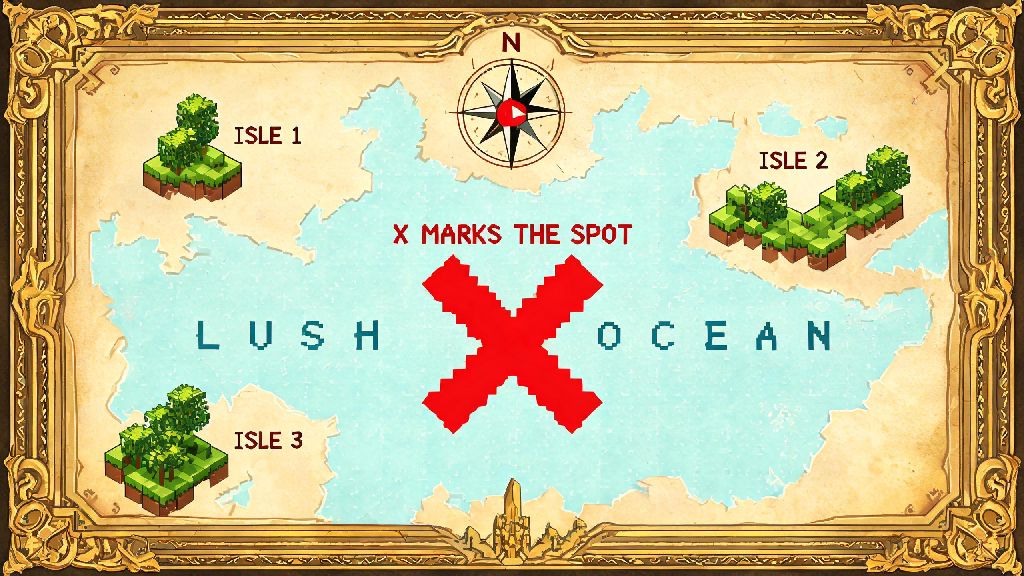
If you’ve ever spent an hour paddling around a warm ocean biome staring at your explorer map wondering why the X won’t line up with your position, you’re not alone. Learning how to find buried treasure in Minecraft is one of the most rewarding early to mid-game goals for survival players, since the chests hold rare loot you can’t easily get elsewhere. I’ve dug up dozens of these chests across both Java and Bedrock editions, and I’ve picked up plenty of tricks to cut down on digging time and skip the frustrating guesswork most new players deal with. You don’t need enchanted tools or high-level gear to pull this off, either—all you need is a map, a shovel, and a little know-how.
How to Find Buried Treasure in Minecraft Using Explorer Maps
Explorer maps are the most reliable way to track down buried treasure, and you can get them two different ways. The first is trading with a journeyman-level cartographer villager, who will exchange a map for 12 to 15 emeralds and a compass. The second is looting shipwrecks or ocean ruins, where roughly 40% of chests contain a buried treasure map for a location within a few thousand blocks of your position.
When you first open a new explorer map, most of it will be blacked out if you’re far from the treasure’s location. You have to be in the same biome as the treasure for the map to fully fill in, so start moving in the direction of the small, partially filled brown section on the map edge until the full map loads. The white dot on the map represents your current position, and the red X marks the exact spot the treasure is buried.
Once you’re close enough that your white dot is sitting directly on the X, you’re in the right spot. Treasure always spawns at Y level 50 to 60 in most biomes, or Y level 40 to 50 in beach biomes, so you never have to dig more than 5 blocks down to find it. Most of the time, it’s only covered by 2 to 3 blocks of sand or gravel, so you’ll hit the chest in seconds if you’re in the right place.
Less Common (But Faster) Ways to Locate Buried Treasure Without a Map
If you don’t want to spend emeralds on a map or haven’t run into any shipwrecks lately, there are a few alternative methods that work just as well, especially if you’re already exploring coastal or ocean biomes. These tricks are also perfect if you lost a map you already picked up, or if you’re playing on a server where cartographer villagers are hard to find.
You can use any of these methods to find treasure without a map:
I’ve used the chunk center trick dozens of times when I’m just exploring beaches, and I’ve found more than a few random treasure chests without ever touching a map. It works because buried treasure always spawns exactly at the center of a chunk, no matter what edition you’re playing on. The only downside is you might dig up a few empty chunk centers before you find one with treasure, so it’s best used if you have extra time to mess around.
What Loot You Can Expect From Buried Treasure Chests
Buried treasure is worth hunting for even if you only care about one specific item, but the rest of the loot is usually good enough to make the trip worth it no matter what. I’ve found everything from enchanted diamond pickaxes to stacks of TNT in these chests, and I’ve never left a treasure dig feeling like I wasted my time.
Every buried treasure chest guarantees 1 heart of the sea, which is the only place you can get this item in vanilla Minecraft. Hearts of the sea are used to craft conduits, which give you unlimited water breathing, night vision, and mining speed underwater when activated. Conduits are game-changing if you’re building an underwater base, exploring ocean monuments, or mining for prismarine, so even if the rest of the chest is full of junk, you still come out ahead.
Other common loot includes enchanted iron and diamond tools, sometimes with mid to high-tier enchants like Efficiency IV or Unbreaking III. You can also find saddles, name tags, emeralds, gold ingots, TNT, and even diamond armor pieces. Bedrock edition players also have a small 7% chance to find an enchanted golden apple in buried treasure chests, which is one of the rarest and most powerful items in the game.
Common Mistakes That Waste Time When Hunting for Treasure
Even with a map, it’s easy to make simple mistakes that add extra time and frustration to your treasure hunt. I’ve made all of these mistakes at least once, so I know how annoying it is to dig around for 20 minutes only to realize you were standing on the wrong chunk the whole time.
The most common mistake new players make is not aligning themselves properly on the map. When you’re far from the treasure, your white dot is small, but it gets larger as you get closer. If your dot is slightly off the X, you’re standing in the wrong spot—move around until the dot is perfectly centered on the red X before you start digging. It’s also easy to mix up north and south on the map, so if you’re not making progress, turn around and try moving the opposite direction.
Don’t dig around underwater without a potion of water breathing or a turtle shell helmet—you’ll end up drowning halfway through digging, which is a super frustrating way to lose your progress and any loot you already picked up. If you don’t have either, wait for low tide in beach biomes, or place blocks above you to create an air pocket while you dig.
Finally, don’t give up too fast if you dig down 3 blocks and don’t find the chest. Sometimes treasure spawns under a layer of stone or dirt instead of sand, so dig 1 or 2 more blocks down before you try a different spot. On Bedrock edition, the map X is sometimes off by 1 block, so check the adjacent chunk centers if you can’t find the chest in the spot you thought was right.
At the end of the day, hunting for loot is one of the most fun parts of survival mode, and once you get the hang of it, you’ll be able to stock up on rare resources in no time. Whether you’re hunting for a heart of the sea to build a conduit for your underwater base, or just looking for extra emeralds to trade with villagers, learning how to find buried treasure in Minecraft is a skill that pays off every single time you use it. Next time you spot a cartographer villager or run into a shipwreck while boating, grab a map and give it a go—you never know what kind of great loot you’ll dig up.